
Petrol Crosses PKR 414: A Practical Guide to Pakistan's Most Fuel-Efficient Cars by Budget
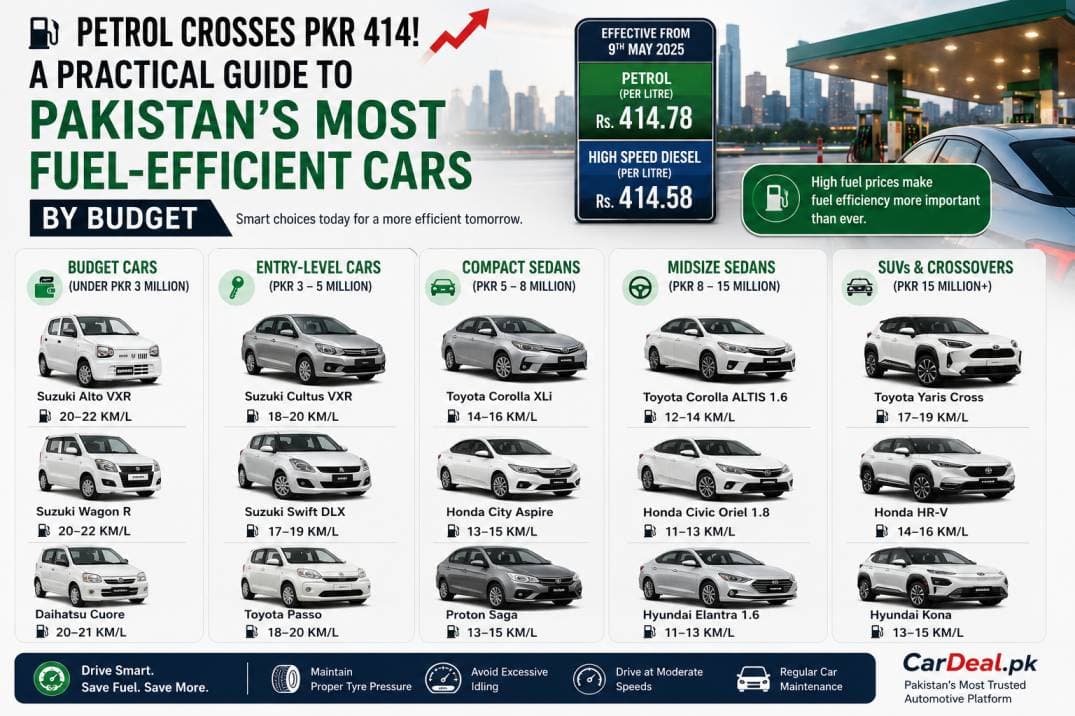
The Government of Pakistan announced another fuel price increase effective May 9, 2026, raising petrol by PKR 14.92 per litre to PKR 414.78 and high-speed diesel by PKR 15 to PKR 414.58. The hike is the latest in a series of weekly revisions since the US-Israeli war on Iran began on February 28 — a conflict that has triggered the closure of the Strait of Hormuz, a global fuel supply crunch, and price volatility that has pushed Pakistani fuel costs to historic highs.
For most car owners reading this, the question is no longer whether fuel prices will keep rising. It's how to think clearly about fuel costs as a permanent feature of car ownership — and how to choose a car that doesn't bleed money every time the government revises prices on a Friday night.
This guide is built to remain useful regardless of where fuel prices land next month or next year. The specific PKR figures will shift; the framework for thinking about fuel efficiency, the math for calculating annual costs, and the model-by-model recommendations for different budgets will not. Whether you're a middle-class buyer trying to keep monthly costs sustainable or an upper-class buyer who simply prefers not to waste money, here's the honest analysis.
How to Actually Think About Fuel Efficiency
Most car buyers in Pakistan think about fuel economy the wrong way. They look at advertised fuel averages — the optimistic km/l figures manufacturers print in brochures — and treat them as facts. They are not facts. They are best-case results from controlled tests at steady speeds, with no AC running, no traffic, and no real-world driving conditions.
The right way to think about fuel efficiency is to use real-world km/l, which is typically 20-30% lower than advertised. A car claimed to deliver 18 km/l will more honestly give you 13-15 km/l in mixed Pakistani driving with AC running, traffic, and the occasional aggressive overtake. Once you anchor your expectations to real-world numbers, the math gets clearer.
Here's the simple formula every car buyer should keep in mind:
Annual fuel cost = (annual km driven ÷ real-world km/l) × current petrol price
For a typical urban Pakistani driver doing 15,000 km per year at the current petrol price of PKR 414.78 per litre:
A car delivering 10 km/l (older 1.5L SUV) costs roughly PKR 6.22 lakh per year in fuel
A car delivering 14 km/l (typical mid-size sedan) costs roughly PKR 4.44 lakh per year
A car delivering 18 km/l (full hybrid SUV) costs roughly PKR 3.45 lakh per year
A car delivering 22 km/l (small hatchback or hybrid sedan) costs roughly PKR 2.83 lakh per year
The difference between a 10 km/l SUV and a 22 km/l small hybrid over five years of ownership is roughly PKR 16.95 lakh — enough to buy a brand-new Suzuki Alto outright. That gap is the actual case for thinking carefully about fuel efficiency, not the marketing-led message that you should always pick the most efficient car you can afford.
The honest reality: fuel efficiency matters most when (a) you drive a lot of kilometres per year, (b) fuel prices are high, and (c) the price gap between the efficient car and a less efficient one is small enough that the fuel savings recover the difference within reasonable ownership timelines. If those conditions aren't met, fuel efficiency is a nice-to-have, not the deciding factor.
The Middle-Class Tier: PKR 30-50 Lakh
This tier is where fuel efficiency arguably matters most, because monthly running costs make or break household budgets. The good news: Pakistan's most fuel-efficient new cars sit in this segment, and the used market offers some genuinely strong options.
Suzuki Alto (PKR 29.95 - 33.26 lakh ex-factory). Pakistan's lowest entry point into new car ownership and, paradoxically, one of the most fuel-efficient cars in the entire local market. The 660cc R-Series engine paired with the AGS automatic delivers a real-world 18-22 km/l in mixed driving — numbers that match or beat almost every other locally-built car. The VXR AGS at PKR 31.6 lakh is the variant most buyers should consider; the manual saves PKR 1.6 lakh but loses convenience in city traffic. The trade-off: highway pace is genuinely poor, and the small body is not ideal for four-adult families. For city commuters and young households, the Alto is the country's best fuel-cost-per-rupee equation today.
Used Suzuki Cultus 1.0L (PKR 22-32 lakh, 2020-2023). Now that the Cultus has been discontinued in Pakistan, the used market becomes the only way to access this car. The 1.0L engine delivers a real-world 14-17 km/l — less efficient than the Alto but with substantially more cabin space and better motorway manners. For families that need more practical room than the Alto offers but can't stretch to a Honda City, a clean used Cultus from a verified seller is one of the most sensible buys in the country.
Used Suzuki Wagon R 1.0L (PKR 22-30 lakh, 2020-2023). Another discontinued model now available only used. The 1.0L delivers 13-16 km/l real-world, with the boxy body offering even more headroom and practical space than the Cultus. Particularly well-suited to families with one or two small children who need a city car with reasonable luggage room.
Used Japanese imports — Toyota Vitz, Daihatsu Mira, Suzuki Alto JDM (PKR 20-35 lakh). This is the underdiscussed middle-class option. Auction-grade imports from Japan, brought in under the gift and baggage schemes, offer genuinely modern small cars at competitive prices. A 2018-2020 Toyota Vitz typically delivers 16-20 km/l real-world; a Daihatsu Mira with mild hybrid technology can deliver 22-26 km/l. The trade-offs are real — parts familiarity outside Karachi, Lahore, and Islamabad is hit-or-miss, and resale value is harder to predict than for locally-built cars. For tech-savvy buyers in major cities with a trusted independent mechanic, the value proposition can be excellent.
The middle-class verdict: A new Suzuki Alto VXR AGS is the most defensible new-car purchase in this tier. A used Suzuki Cultus 1.0L is the most defensible used-car purchase. For buyers willing to accept import-market complexity, a 2018-2020 Toyota Vitz or Daihatsu Mira hybrid genuinely offers the best fuel economy at this budget.
The Upper-Middle Tier: PKR 50-80 Lakh
This tier is where the conversation gets more interesting because the budget allows for either a larger conventional petrol car or a smaller car with hybrid-adjacent technology. Both directions have honest cases.
Honda City 1.2L CVT (PKR 47.37 lakh ex-factory). The most fuel-efficient sedan in the locally-built lineup. The 1.2L i-VTEC paired with CVT delivers a real-world 14-16 km/l in mixed driving — meaningfully better than the City 1.5L variants and beating the Toyota Yaris on fuel economy by a small but consistent margin. For buyers who want a sedan body, modest engine, and the Honda Atlas service network, this is the segment's best fuel-cost answer.
Suzuki Swift (PKR 42-50 lakh range). The 1.2L petrol Swift delivers 14-17 km/l real-world — competitive with the City 1.2L on efficiency and with a smaller, more agile city footprint. The Swift's resale curve is not as strong as the City's, and the cabin is tighter, but for single drivers and small families prioritising fuel economy, it's a sensible alternative.
Toyota Yaris 1.3L (PKR 46.49-54.49 lakh). The 1.3L 2NR-FE delivers 13-16 km/l real-world — slightly less efficient than the Honda City 1.2L but with the advantage of Toyota's deeper service network and stronger resale. The GLI CVT at PKR 49 lakh is the variant that makes most sense for fuel-conscious buyers in this segment.
Suzuki Fronx GLX (PKR 62.99-63.75 lakh). Pak Suzuki's just-launched mild-hybrid crossover. The 1.5L K-Series with mild hybrid assistance delivers an expected 14-17 km/l real-world — meaningful improvement over the Fronx GL variants but well short of full-hybrid territory. The "hybrid" badge is doing more marketing work than engineering work, but for buyers who want crossover styling with marginally better fuel economy than equivalent sedans, the GLX is the only Fronx variant worth considering.
Used Toyota Prius (Gen 3-4 imports, PKR 50-75 lakh). Here is where the import market becomes genuinely transformative. A 2015-2019 Toyota Prius brought in as a JDM auction-grade import delivers a real-world 22-26 km/l — figures that completely change the running-cost equation in this segment. The Prius is a proper full-hybrid that can run on electric power alone at low speeds, with battery durability now well-documented past 200,000 km. The trade-offs: hybrid mechanic familiarity in Pakistan is concentrated in major cities, parts cost more than for locally-built cars, and the resale market is still developing. For buyers in Karachi, Lahore, or Islamabad with access to a qualified hybrid technician, a clean Prius import is one of the most fuel-efficient cars anyone in Pakistan can own at any price.
Used Toyota Aqua imports (PKR 35-55 lakh). The Prius's smaller, cheaper sibling. A 2017-2020 Aqua import delivers a real-world 20-25 km/l with similar full-hybrid technology in a subcompact body. For buyers in this budget who want maximum fuel economy without stepping into the higher-budget hybrid SUV segment, the Aqua is genuinely the smartest choice on running cost — though again, the import-market complexity applies.
The upper-middle verdict: A new Honda City 1.2L CVT for buyers who want simplicity and dealer support; a used Toyota Prius or Aqua import for buyers who want maximum fuel economy and can navigate the import market.
The Premium Tier: PKR 80-120 Lakh
This is where full hybrid technology becomes properly accessible — and where the fuel-economy math starts to genuinely justify the higher purchase price for high-mileage drivers.
Toyota Corolla Cross HEV (PKR 84-89.35 lakh ex-factory). Toyota IMC's only hybrid offering in Pakistan, and arguably the most strategically important car in the premium fuel-efficient segment. The 1.8L 2ZR-FXE hybrid system delivers a real-world 18-20 km/l — a roughly 65-70% improvement over the petrol Corolla Cross, and a 30-40% improvement over comparable conventional SUVs. With petrol at PKR 414.78, a Corolla Cross HEV saves roughly PKR 1.91 lakh per year over its petrol equivalent for a 15,000 km/year driver. The PKR 12-14 lakh hybrid premium now pays back in roughly 7-8 years at typical mileage — comfortably within ownership timelines for most buyers.
Honda HR-V e:HEV (PKR 89.99 lakh ex-factory). The most fuel-efficient locally-built SUV in Pakistan. Honda's e:HEV system delivers a real-world 17-23 km/l with strong performance characteristics, six airbags, Honda Sensing safety suite, and a more refined cabin than the Corolla Cross HEV. For buyers in this budget prioritising the latest hybrid technology with full local dealer support, the HR-V e:HEV is the segment's strongest pick.
Hyundai Elantra Hybrid (PKR 98.95 lakh ex-factory). The only locally-available hybrid sedan in Pakistan. The 1.6L hybrid system delivers a real-world 18-22 km/l with strong highway efficiency. For buyers who want a sedan body rather than an SUV body in this fuel-efficient segment, the Elantra Hybrid is the only direct option. Hyundai Nishat's dealer network is meaningfully thinner than Toyota or Honda's, which matters for buyers outside major cities.
Haval Jolion HEV (PKR 70-82 lakh range). The cheapest full-hybrid SUV in Pakistan, sitting just below the Corolla Cross HEV on price. Haval's hybrid system delivers a real-world 16-19 km/l — slightly less efficient than the Corolla Cross HEV but at a meaningfully lower price point. The trade-off: Pakistan's Haval service network is still developing, and long-term reliability data is limited. For early-adopter buyers in major cities, the Jolion HEV is genuinely competitive.
Used Toyota Prius newer-generation imports, Honda Vezel Hybrid imports (PKR 80-120 lakh). A clean 2020-2022 Prius import delivers 22-26 km/l real-world; a Honda Vezel Hybrid (the JDM equivalent of the HR-V e:HEV) delivers 18-22 km/l. Both offer more current technology than locally-built equivalents at similar money.
The premium verdict: Honda HR-V e:HEV for the strongest combination of efficiency, features, and dealer support. Toyota Corolla Cross HEV for buyers who prioritise Toyota's deeper service network. The Hyundai Elantra Hybrid for sedan loyalists.
The Upper-Class Tier: PKR 120+ Lakh
For upper-class buyers, fuel efficiency is rarely the primary purchase driver — but for those who genuinely care about reducing their environmental footprint or simply prefer not to waste money on fuel, the options are genuinely strong.
Toyota Camry Hybrid imports (PKR 1.2-1.6 crore range). A 2018-2022 Toyota Camry Hybrid imported as a JDM auction-grade vehicle delivers a real-world 17-22 km/l in a full-size luxury sedan. For buyers who want a properly large car with hybrid economy, the Camry Hybrid is one of the most refined options available in Pakistan.
Lexus CT200h, NX300h, RX450h hybrid imports (PKR 1.0-2.5 crore range). Lexus's hybrid range, brought in via the import market, offers genuine luxury cabin experience with full hybrid technology. The CT200h delivers 22-26 km/l (essentially Prius-level efficiency in a luxury body); the NX300h SUV delivers 16-20 km/l; the RX450h large SUV delivers 14-18 km/l. All three deliver fuel economy that comfortably beats conventional petrol equivalents in their respective segments.
Toyota Highlander Hybrid, Honda Pilot Hybrid imports (PKR 2.0-3.5 crore). Three-row family hybrid SUVs imported from Japan or the US. Real-world fuel economy of 12-16 km/l in a vehicle that would typically deliver 7-9 km/l with a conventional petrol engine. For large families that need genuine seven-seat capacity and don't want to sacrifice fuel economy, these are the most sensible options.
Electric vehicle considerations. Cars like the BYD Atto 3, MG ZS EV, and Audi e-tron are now available in Pakistan with proper local dealer support. Per-kilometre running costs for EVs are roughly PKR 4-6 (versus PKR 25-35 for an efficient petrol car at current prices) — a transformative reduction. The constraints are charging infrastructure (still concentrated in major cities), home charging requirements, and battery replacement costs over a long ownership timeline. For upper-class buyers in Karachi, Lahore, or Islamabad with home charging access, EVs now make genuine financial sense alongside their environmental case.
What to Do Beyond the Car Choice
Choosing a fuel-efficient car is the biggest single decision, but real-world fuel costs are also affected by how you actually drive and maintain the car. The following adjustments typically deliver 5-15% improvement in real-world fuel economy regardless of which car you own:
Maintain correct tire pressure. Underinflated tires can reduce fuel economy by 3-5%. Check pressure monthly using a reliable gauge — not the petrol pump's gauge, which is often inaccurate. The recommended PSI for your car is on the inside of the driver's door panel.
Drive smoothly. Aggressive acceleration and hard braking can reduce fuel economy by 15-30% versus smooth driving. The single biggest behavioural change for fuel efficiency is anticipating traffic flow and easing off the throttle earlier.
Use cruise control on highways. Maintaining steady speed on motorways improves fuel economy by 7-14% compared to manual throttle control.
Don't idle unnecessarily. Idling for more than 30 seconds uses more fuel than restarting the engine. Modern cars handle frequent restarts without engine wear.
Service on schedule. A clogged air filter, worn spark plugs, or dirty fuel injectors can each reduce efficiency by 5-10%. Following the manufacturer's service intervals is genuinely cost-effective, not just precautionary.
Reduce weight. Every 50kg of unnecessary weight in the car (old gym equipment in the boot, building materials, etc.) reduces fuel economy by roughly 1-2%. Empty the car of what you don't need.
Plan routes to avoid traffic. Idling in traffic is the worst possible fuel-economy condition. Apps like Google Maps showing real-time traffic can save 10-20% on fuel costs over a year for daily commuters.
A Note on Tracking Fuel Prices
Fuel prices in Pakistan now revise weekly — often on Friday nights — making it difficult to keep mental math current. CarDeal.pk maintains a live fuel prices tracker that updates with every official revision, so buyers can recalculate their annual fuel costs whenever prices change. For buyers shopping across the budget tiers above, plug your annual mileage and your current car's real-world km/l into the formula at the start of this guide, then compare the result against the same calculation for any car you're considering. The number that comes out is the actual annual saving — not a marketing claim.
The Final Framework
Whether fuel prices stay near PKR 415, climb higher, or eventually moderate, the framework for choosing a fuel-efficient car remains constant:
Anchor to real-world km/l, not advertised numbers. Knock 20-30% off any brochure figure to get a defensible expectation.
Calculate annual fuel cost honestly using your actual mileage. A 25,000 km/year ride-share driver and a 8,000 km/year weekend driver have completely different fuel-economy priorities.
Compare fuel savings against the price premium of the more efficient car. If the savings recover the premium within 5-7 years for typical drivers, the efficient car is the smarter buy. If recovery takes 10+ years, the efficient car is a lifestyle choice rather than a financial one.
Consider the used import market for hybrid technology your budget can't otherwise reach. A used Toyota Aqua at PKR 50 lakh delivers fuel economy that matches or beats new locally-built hybrids costing twice as much.
Practical driving and maintenance habits compound with the car's underlying efficiency. A well-driven, well-maintained 14 km/l car can outperform a poorly-driven 18 km/l car in real-world running costs.
For most Pakistani buyers in 2026, the smartest fuel-efficient purchases are: a new Suzuki Alto VXR AGS for the entry tier, a new Honda City 1.2L CVT or used Toyota Aqua import for the upper-middle tier, a Honda HR-V e:HEV or Toyota Corolla Cross HEV for the premium tier, and used JDM hybrid imports across all tiers for buyers in major cities with import-market access.
The fuel hike on May 9, 2026 is not the end of the story. It's the latest chapter in a longer reality of higher running costs that look unlikely to reverse meaningfully. The good news is that genuinely fuel-efficient cars now exist at every budget tier in Pakistan — including, for the first time, full-hybrid SUVs from Toyota and Honda with proper local dealer support. Choosing the right one is more important now than it has ever been.
Looking for a fuel-efficient car in Pakistan? Browse verified hybrid, mild-hybrid, and small-engine listings on CarDeal.pk. Track live fuel prices at cardeal.pk/fuel-prices and recalculate your running costs whenever the government revises rates.
CarDeal
Bringing you the latest automotive news and insights from Pakistan