Toyota Corolla Cross 2026 Pakistan: The Honest Buyer's Guide to Toyota's Only Hybrid
Prices verified as of April 30, 2026. This guide is refreshed quarterly (January, April, July, October) to keep numbers current.
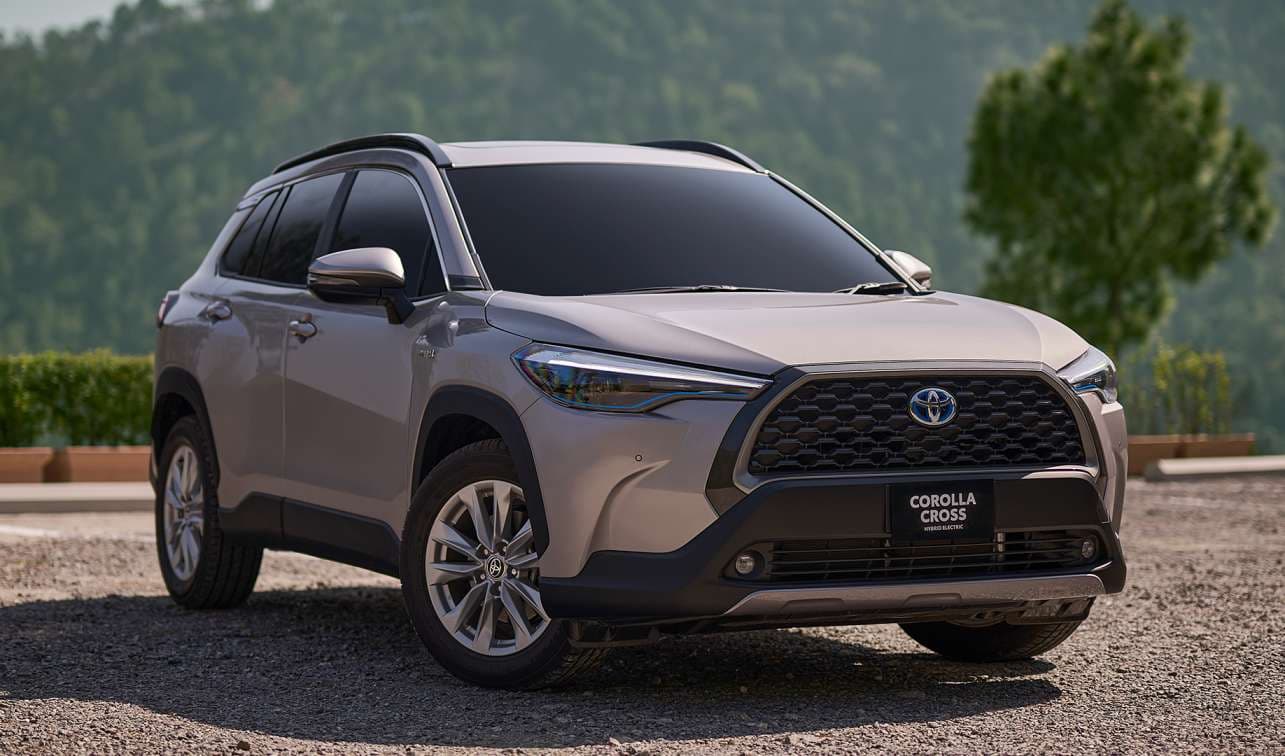
The Toyota Corolla Cross occupies a strange position in Pakistan's auto market. On paper it's a compact crossover SUV, slotting into a category dominated by the Hyundai Tucson, Kia Sportage, MG HS, and Haval Jolion. In practice, it's Toyota IMC's only hybrid offering in the entire country — and that single fact reshapes every buying decision around the car.
Pakistan does not get the Corolla Hybrid sedan that's available in nearly every other major Toyota market. We don't get the RAV4 Hybrid. We don't get the Camry Hybrid. The Hilux is petrol-only. The Yaris is petrol-only. The Fortuner is petrol or diesel. If you walk into a Toyota showroom in Karachi or Lahore in 2026 and ask for a hybrid, the only car the salesman can sell you is the Corolla Cross HEV. That positioning matters, and it explains both why Toyota IMC has invested in the Cross as a model, and why the petrol-vs-hybrid decision sits at the heart of every honest review.
Most of the existing buyer's guides on the Corolla Cross treat it as a straightforward SUV comparison — list the variants, compare features, recommend the top trim. That misses the actual buying decision most readers face. The Cross isn't really a single-question purchase. It's two: should you buy a petrol Cross at all when a Corolla Grande exists for the same money, and if you go hybrid, does the PKR 12 lakh premium genuinely pay back? This guide tries to answer both honestly.
The 2026 Lineup at a Glance
For 2026, Toyota IMC offers four variants of the Corolla Cross, split evenly between petrol and hybrid drivetrains. All variants are locally assembled (CKD) at the IMC plant.
Variant | Engine | Transmission | Ex-Factory Price |
|---|---|---|---|
Corolla Cross 1.8 | 1.8L petrol | CVT | PKR 7,235,000 |
Corolla Cross 1.8 X | 1.8L petrol | CVT | ~PKR 7,700,000 |
Corolla Cross 1.8 HEV | 1.8L hybrid | E-CVT | ~PKR 8,400,000 |
Corolla Cross 1.8 HEV X | 1.8L hybrid | E-CVT | PKR 8,935,000 |
These are ex-factory prices. Real on-road costs land meaningfully higher once registration, withholding tax, freight, and insurance are added. The full price band runs from PKR 72.35 lakh to PKR 89.35 lakh ex-factory; on-road for a non-filer typically lands between PKR 80 lakh on the base petrol and PKR 99–100 lakh on the top hybrid.
The hybrid premium is roughly PKR 12 lakh over the petrol equivalent — a number that defines the entire Corolla Cross buying decision and that we'll come back to in detail.
Variant-by-Variant: What You Actually Get
Corolla Cross 1.8 Petrol (PKR 72.35 lakh). The base petrol variant, and the variant with the hardest case to make. You get the 1.8L 2ZR-FE petrol engine making 138 hp, paired with a CVT transmission, Toyota's basic feature set, and the Cross's compact-SUV body. Standard equipment includes dual airbags, ABS, fabric seats, 7-inch infotainment, basic LED headlamps, and 17-inch alloys. The honest question this variant raises: at this price, why not buy a Corolla Grande X (PKR 76.09 lakh ex-factory) instead? The Grande gives you the same 1.8L engine, more features inside, the same Toyota service network, and historically stronger resale. The Cross 1.8 petrol exists primarily to give the Cross lineup a sub-PKR 80 lakh entry point — but most buyers shopping at this price would be better served by the Corolla sedan.
Corolla Cross 1.8 X Petrol (~PKR 77 lakh). The petrol upper trim, and a variant that doubles down on the same problem. You get the same 1.8L engine, but with feature upgrades — push-start, climate control, leather-wrapped steering, slightly better infotainment, additional safety equipment. You're now paying within striking distance of the Corolla Grande Black (PKR 77.09 lakh) and not far below the entry-level hybrid. For a buyer who genuinely wants the SUV body style but doesn't want hybrid, this is the variant that makes the most sense — but the case is narrower than Toyota's marketing suggests.
Corolla Cross 1.8 HEV (~PKR 84 lakh). The base hybrid, and where the Cross's case for existing actually starts. You get the 1.8L 2ZR-FXE hybrid engine making 98 hp paired with a 72 hp electric motor for a combined output of roughly 122 hp, an E-CVT transmission, regenerative braking, EV/Eco/Power drive modes, and a meaningful jump in real-world fuel economy. Standard equipment includes everything in the petrol X plus the hybrid system, slightly upgraded interior trim, and Toyota's hybrid badging. For a buyer who wants Toyota reliability with genuine fuel economy gains, this is the entry point.
Corolla Cross 1.8 HEV X (PKR 89.35 lakh). The top of the lineup. Same hybrid powertrain as the HEV, with the full feature list — panoramic sunroof, 9-inch floating infotainment with Apple CarPlay and Android Auto, powered seats with Terra Rossa upholstery, blind-spot monitor, kick-sensor power tailgate, automatic rain sensors, and the more polished exterior treatment. This is the variant that genuinely competes feature-for-feature with the Hyundai Tucson and Kia Sportage in the same money. For a buyer prioritising hybrid economy, modern features, and the SUV body, this is the correct Cross.
The honest take: the Cross lineup essentially boils down to one decision — petrol or hybrid — and one variant choice within whichever drivetrain you pick. The 1.8X petrol and HEV are the sensible mainstream choices; the base 1.8 petrol is hard to justify against the Corolla Grande, and the HEV X is the top-end answer for buyers who want the full feature set.
The Hybrid Math: Does the PKR 12 Lakh Premium Pay Back?
This is the central buying question, and most reviews skip it. Let's actually run the numbers.
The hybrid premium over the equivalent petrol variant is roughly PKR 12 lakh ex-factory — closer to PKR 14 lakh once on-road costs are factored in. The hybrid's real-world fuel economy in mixed driving is roughly 18–20 km/l versus 11–13 km/l for the petrol. That's a meaningful gap, but smaller than Toyota's marketing claims of 22–25 km/l, which reflect optimal conditions.
For a buyer doing 15,000 km per year — roughly average for a Pakistani family car — the math works out roughly as follows. At a petrol price near PKR 250/litre (current 2026 levels), the petrol Cross consumes about 1,250 litres of fuel per year. The hybrid consumes about 800 litres. That's a saving of 450 litres per year, or roughly PKR 1.12 lakh annually.
At that rate, the PKR 14 lakh hybrid premium pays back over roughly 12–13 years. For most Pakistani car buyers, that's longer than typical ownership.
The honest conclusion: the hybrid's PKR 12–14 lakh premium does not pay back through fuel savings alone within typical ownership timelines. It pays back faster for high-mileage drivers (25,000+ km per year) and ride-share operators, where the 12-year payback can compress to 5–6 years. It also recovers through stronger resale value, since hybrid buyers in the used market are willing to pay a premium for the technology — meaning the PKR 14 lakh you spend extra is likely to come back as a higher resale price.
For everyone else, the hybrid is a lifestyle decision, not a financial one. You buy it because you want to use less fuel and reduce your environmental footprint — not because the math works on paper.
The On-Road Cost Reality
For the Cross HEV X, total on-road costs typically land around PKR 95 lakh for filers and PKR 99–100 lakh for non-filers — a gap of roughly PKR 5 lakh on the same car. Toyota Central's pricing sheet shows withholding tax around PKR 268,785 for filers and PKR 806,355 for non-filers on the top variant — a difference of more than PKR 5.3 lakh in withholding tax alone.
For a buyer in this price segment, becoming a tax filer before booking saves more money than any factory promotion or dealer negotiation will produce. The hassle of becoming a filer is paid back the day your car gets registered.
What the Toyota Corolla Cross Gets Right
The case for the Cross — particularly in HEV form — rests on four pillars:
The only locally-supported hybrid in this segment. While the Hyundai Elantra Hybrid sedan and a handful of MG/Haval hybrid variants exist, the Corolla Cross is the only hybrid SUV in Pakistan with full Toyota IMC dealer support, parts depth, and warranty coverage across the country. For buyers who genuinely want hybrid technology with the safety net of Pakistan's deepest service network, the Cross is uniquely positioned.
Genuine fuel economy in HEV form. Real-world 18–20 km/l in mixed driving is meaningful in the SUV category. Compared to a Tucson's 9–11 km/l or a Sportage's 10–12 km/l, the Cross HEV cuts running costs by roughly 40% over a year. With petrol prices where they sit in 2026, that compound saving is real.
Toyota reliability track record. The 2ZR-FXE hybrid engine has been in production globally since 2009 and has accumulated millions of miles of real-world data. Failure modes are well-documented; the hybrid battery has shown durability well past 200,000 km in multiple markets; mechanic familiarity in Pakistan is rapidly growing through Toyota IMC dealer training. For a country where buyers historically distrust new technology, the hybrid system in the Cross is among the most proven globally.
Strong resale curve emerging. Used market data on the Cross is still developing — the model only launched in Pakistan in 2022 — but early signals suggest the HEV variants are holding 70–75% of original value at the 2-3 year mark. That's competitive with the Corolla sedan and stronger than most Korean and Chinese SUV competitors.
Where the Toyota Corolla Cross Falls Short
The criticisms are also real:
Cabin experience feels less premium than its competitors. Owners and reviewers consistently note that the Cross interior, while well-built, feels more functional than premium for its price point. The Hyundai Tucson and Kia Sportage at similar money offer larger touchscreens, more sophisticated material choices, and better-feeling switchgear. If you cross-shop Korean SUVs, the Cross can feel under-equipped on the inside.
Underpowered for its size. The hybrid system's combined 122 hp is sufficient for city use but feels strained on inclines, motorway overtakes, or with a full passenger and luggage load. Compared to the Tucson 2.0L (155 hp) or Sportage 2.0L (155 hp), the Cross is genuinely the slower car. For buyers who do regular motorway driving with a full family, this matters.
Petrol variant value proposition is weak. As noted earlier, the base 1.8 petrol struggles to make a case against the Corolla Grande in the same showroom. Toyota IMC has not given the petrol Cross a meaningful identity beyond "Corolla Cross without the hybrid bit," and the variant feels like a placeholder rather than a serious purchase.
Limited cargo space for an SUV. With the rear seats up, the Cross offers less cargo capacity than the Tucson or Sportage — a side effect of the hybrid battery placement and the Corolla-derived platform. Families that regularly carry sports gear, school bags, and groceries simultaneously will notice.
Dealer markups remain a problem. Despite Toyota IMC's official pricing, several dealers have reportedly added own-money premiums of PKR 1–3 lakh on hybrid variants during periods of high demand. Verify the booking terms carefully and refuse to pay any premium beyond the published ex-factory price plus official taxes.
New vs Used: A Limited but Growing Market
The used Corolla Cross market is still developing. The car only launched in Pakistan in 2022, so the oldest used examples are 2-3 years old. A clean 2023 HEV X with around 35,000 km typically sells in the PKR 70–75 lakh range on verified listings — a saving of roughly PKR 25 lakh against new on-road for a non-filer.
That's a meaningful saving on a car that has effectively the same mechanical life ahead of it. The first owner has absorbed the worst of the depreciation curve. For 2-3 year old hybrid examples specifically, battery condition data is now starting to emerge, and the news is broadly positive — Toyota's hybrid system continues to perform within original specifications well past the early-life period.
The catch with used Cross buying is supply. Used inventory is genuinely limited, prices are firm, and the discount-from-new is smaller than for older models like the Corolla sedan. If you find a clean used HEV X from a verified seller at PKR 72–75 lakh, take it. If you can't, the case for a new HEV (rather than HEV X) becomes more defensible than for most other categories.
Competitor Reality Check
In 2026, the Cross's competitive landscape looks like this:
Hyundai Tucson (PKR 80–110 lakh range). The Tucson is the most direct competitor and arguably the better-equipped car at similar money. The mid-spec Tucson offers more cabin space, larger infotainment, more rear-seat legroom, and sharper styling. It loses to the Cross HEV on fuel economy and Toyota's service network depth. Pick based on whether you prioritise modern cabin experience (Tucson) or hybrid economy plus Toyota reliability (Cross).
Kia Sportage (PKR 78–95 lakh range). Mechanically related to the Tucson but with sportier styling and slightly different interior treatment. Same conclusion as the Tucson — better modern cabin, less efficient engine, less mature dealer network than Toyota.
MG HS (PKR 65–80 lakh range). Cheaper than the Cross by PKR 7–10 lakh with a longer feature list. Loses on resale value, parts familiarity, and proven reliability data. For buyers who plan to keep the car five-plus years and don't intend to resell aggressively, the MG HS is genuinely competitive on price-to-feature ratio. For most middle-class Pakistani buyers, the Cross's resale curve quietly recovers most of the price difference.
Haval Jolion HEV (PKR 70–82 lakh range). The closest hybrid SUV competitor on price. Offers genuinely strong feature equipment but with Pakistan's still-developing Haval service network. For buyers in major cities with a tolerance for early-adopter risk, the Jolion HEV is a real consideration. For buyers in smaller cities, the Cross's Toyota dealer footprint wins by default.
Toyota Corolla Grande (PKR 76.09–77.09 lakh ex-factory). The Cross's strangest competitor — a car from the same showroom that solves a different problem. The Grande offers more sedan space, lower price, the same engine in petrol form, and historically stronger resale. For buyers who want a Toyota at this price band but don't need the SUV body, the Grande is genuinely the smarter choice.
The Verdict
If you're buying a new Corolla Cross in 2026, here's our honest read:
Best overall value: Corolla Cross 1.8 HEV (mid hybrid). Captures the entire reason this car exists at the most defensible price point.
Best for feature buyers: Corolla Cross 1.8 HEV X. Top variant, full feature list, genuinely competitive against the Hyundai Tucson and Kia Sportage.
Best for high-mileage drivers: Corolla Cross 1.8 HEV. Ride-share operators, frequent motorway commuters, or 25,000+ km/year drivers — this is where the hybrid economics actually pay back within reasonable timeframes.
Hardest to justify: Corolla Cross 1.8 base petrol. At this price, a Corolla Grande is the smarter purchase from the same showroom.
Don't buy if: You don't drive enough miles to make the hybrid premium pay back, you don't need the SUV body, and you want the most car for your money. Buy a Corolla Grande and put the savings to better use.
Should You Wait for the Next-Generation Corolla Cross?
The Corolla Cross is currently in its first generation globally, having launched internationally in 2020 and arrived in Pakistan in 2022. There is no announced timeline for a generational refresh. Toyota's pattern suggests at least 4–5 more years before the next-generation Cross arrives. In the interim, expect minor mid-cycle facelifts and feature additions.
Our honest take: don't wait. The Cross is currently a fresh-platform car by Pakistani standards (compared to the 12-year-old Corolla sedan platform), and any future replacement is years away with pricing that will reflect 2028+ duty structures. If you want a Toyota hybrid SUV, the time to buy is now or via a clean 2-3 year old used example.
Final Thoughts
The Corolla Cross in 2026 is exactly what its position in Toyota IMC's lineup dictates: the only hybrid you can buy from Pakistan's most trusted automaker, in a body style that fits where the market is moving, at a price that reflects both genuine technology investment and Pakistan's tax-and-duty reality. It is not the best-equipped SUV in its segment. It is not the fastest. It is not the largest inside. But it is the only one that combines genuine hybrid economy with Toyota's service depth — and for a meaningful slice of Pakistani buyers, that combination is what they're actually buying.
If you walk into a Toyota showroom expecting a fully modern hybrid SUV that competes feature-for-feature with the Hyundai Tucson, the Cross will leave you slightly disappointed. If you walk in wanting Toyota reliability with hybrid economy, in an SUV body, with the safety net of Pakistan's deepest dealer network, the Cross HEV X is exactly that car.
For most readers seriously considering this segment, the right answer is either a new Corolla Cross HEV (mid hybrid, sensible budget) or a clean 2-3 year old HEV X. The petrol variants exist mostly as a price ladder rather than a serious purchase.
Looking for a Toyota Corolla Cross in Pakistan? Browse verified Cross listings on CarDeal.pk and filter by variant, year, city, and price. We do the haggling math for you.
CarDeal
Bringing you the latest automotive news and insights from Pakistan