Budget 2026-27 and Pakistan's Auto Sector: Who Actually Wins, Who Pays More
Published June 12, 2026 — the day of the budget speech. Details below are based on the Finance Minister's address and initial Finance Bill reporting; we will update this post as the full budget documents are analysed. Figures marked as proposed are subject to National Assembly approval.
Finance Minister Muhammad Aurangzeb presented the federal budget for FY2026-27 in the National Assembly today, the government's third budget, with a total outlay of roughly Rs18.7 trillion presented under the shadow of the ongoing Middle East crisis and elevated fuel prices.
For Pakistan's auto sector, the budget delivers a package that headlines will simplify in both directions — some will call it billions in relief for the industry, others will call it new taxes on car buyers. Both framings are partially true, and neither tells the full story. The honest summary: this budget cuts costs for local manufacturers, raises costs on imported and large-engine vehicles, keeps the electric vehicle subsidy machine running, and quietly defers the single biggest auto decision of the year.
Here's what was actually announced, what it means for each kind of buyer, and what got kicked down the road.
What Was Announced: The Full Auto Package
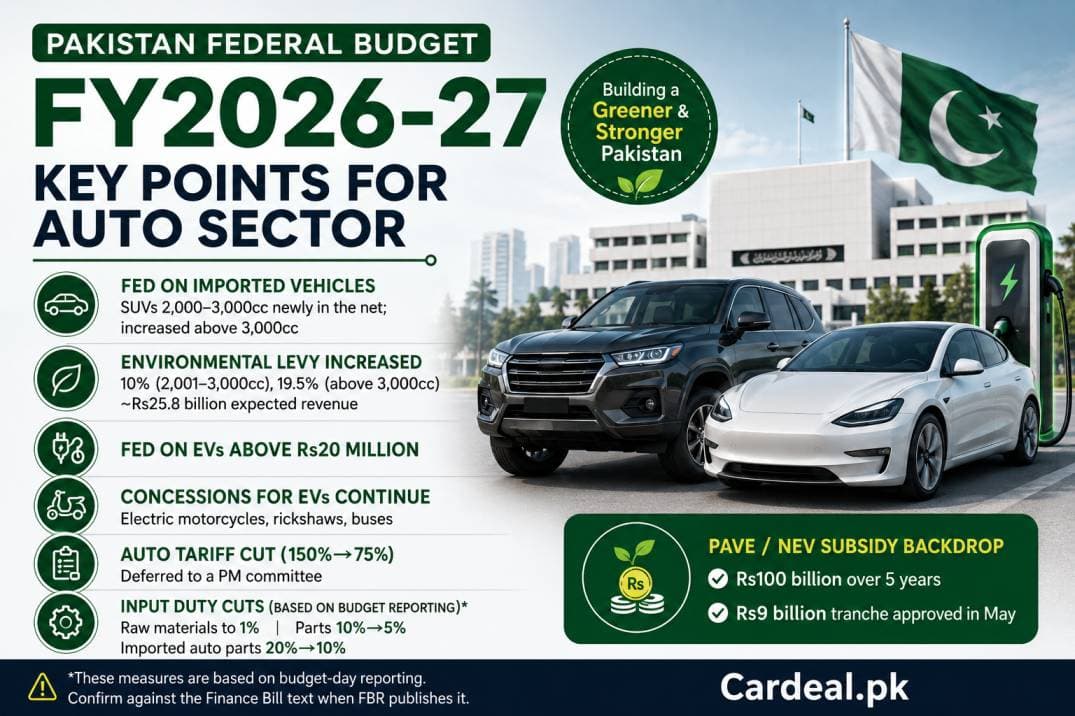
New Federal Excise Duty on imported vehicles. The government has decided to impose FED on imported vehicles, with SUVs between 2,000cc and 3,000cc newly brought into the FED net, and excise duty increased further on vehicles above 3,000cc. The stated rationale is curbing luxury imports that pressure foreign exchange reserves.
An Environmental Levy on large-engine vehicles. The budget proposes a 10% levy on petrol and diesel vehicles with engine capacities between 2,001cc and 3,000cc, and a 19.5% levy on vehicles exceeding 3,000cc. The government expects to raise approximately Rs25.8 billion from these collections — making this less an environmental measure and more a revenue measure wearing green clothing, a pattern consistent with the Carbon/Climate Support Levy introduced in last year's budget.
FED on expensive electric vehicles. EVs priced above Rs20 million will now attract Federal Excise Duty. This is a notable shift: until now, EVs enjoyed near-blanket exemption as part of the NEV push. The government's position is that buyers of Rs20-million-plus electric vehicles do not need taxpayer-funded concessions — which, frankly, is hard to argue with.
Duty cuts on local manufacturing inputs. This is the substance behind the "relief for the auto industry" headlines. Based on budget reporting, tax on imported raw materials is being reduced to 1%, import duty on parts used in local manufacturing is being cut from 10% to 5%, and tax on imported auto parts for the local industry is being reduced from 20% to 10%. For locally assembled vehicles — which is most of what Pakistanis buy — these input-cost reductions are the genuinely pro-industry measures in this budget.
A localisation stick to go with the carrot. Manufacturers will be required to pass 62 key safety and quality standard tests, and concessional tax benefits can be withdrawn if manufacturers fail to localise parts production. Whether this enforcement materialises is the perennial question — Pakistan's auto policy history is littered with localisation targets that were extended, renegotiated, or quietly forgotten.
EV concessions for small vehicles continue. The Finance Minister explicitly confirmed that existing concessions for electric motorcycles, rickshaws, and buses remain in place. This sits alongside the PAVE (Pakistan Accelerated Vehicle Electrification) Program, which was already approved to provide roughly Rs100 billion in subsidies over five years through 2030 — including the Rs9 billion tranche approved last month for electric bikes, loaders, and rickshaws. This rolling program, funded through the NEV Adoption Levy collected on conventional vehicles, is the "billions in subsidy" that the auto sector is genuinely receiving — but note carefully who it goes to: two-wheelers and three-wheelers first, not cars.
The big one was deferred. The most consequential auto decision of the year — the Tariff Policy Board's recommendation to slash maximum vehicle import duty from 150% to 75% — was not implemented in this budget. The Prime Minister has constituted a committee to examine the proposal, and the Finance Minister confirmed during the speech that the new auto policy remains under review. Officials quoted in pre-budget reporting were blunt about what this means: continued shielding of the local assembly industry, and an effective delay to the five-year tariff reform plan agreed with the IMF.
What This Means For You, By Buyer Segment
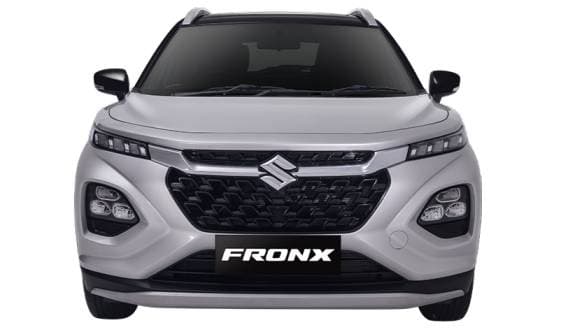
If you're buying a locally assembled car (Alto, City, Yaris, Corolla, Fronx, Corolla Cross and most of the market): This budget is mildly positive, with an asterisk. The input duty cuts reduce manufacturer costs on imported parts and raw materials. In a competitive market, that would translate into price relief. In Pakistan's market — where assemblers have historically absorbed cost reductions into margins while passing cost increases to buyers within weeks — the honest expectation is price stability rather than price cuts. Watch what Pak Suzuki, Indus Motor, and Honda Atlas do with prices over the next 60 days; their response will tell you whether the savings reach buyers or stay in Karachi head offices.
If you're buying an imported vehicle: Costs are going up. New FED on imports, the environmental levy on engines above 2,000cc, and the deferral of the tariff cut all stack against you. A 2,400cc imported SUV now carries FED it didn't carry yesterday plus a 10% environmental levy. The window some buyers were waiting for — the rumoured duty crash from 150% to 70-75% — has not arrived, and given the committee review, may not arrive for months, if at all this fiscal year.
If you're buying a large-engine vehicle (above 2,000cc), local or imported: The environmental levy applies to you. On a vehicle in the Rs1.5-2 crore range, a 10% levy is Rs15-20 lakh of new cost. Above 3,000cc, the 19.5% rate makes large SUVs and luxury sedans meaningfully more expensive. If you were planning a Land Cruiser, Prado, or large imported SUV purchase, the math just changed — and note the booking-versus-invoice-date risk: under prevailing rules, it is the factory invoice date that determines applicable taxes, so a vehicle booked before June 30 but invoiced after can still fall under the new structure.
If you're buying an affordable EV (under Rs20 million): Nothing changed for you today, and that's good news. The mainstream EV options in Pakistan — BYD Atto 3, MG ZS EV, and the wave of Chinese EVs arriving under the NEV policy — sit below the Rs20 million FED threshold and retain their concessional treatment. The budget's EV signal is consistent: the government wants you in an electric car, as long as it isn't a luxury one.
If you're buying an electric bike or rickshaw: You remain the budget's favourite person. Concessions confirmed, the PAVE subsidy program continues, and the next application window under the scheme is expected later this year. For commuters crushed by PKR 414-per-litre petrol, a subsidised electric bike is now one of the most heavily state-supported purchases in the country.
If you're holding a used car or planning to sell: The deferral of import liberalisation is quietly good news for your resale value. A flood of cheap imported used cars would have pressured local used prices downward. That flood has been postponed. Used Corollas, Citys, and Altos retain their scarcity premium for at least another budget cycle.
The Honest Analysis: Protection Continues, Dressed Differently
Step back from the individual measures and a clear pattern emerges. This budget continues Pakistan's long-standing protection of local assembly — but the protection now wears two new outfits.
The first outfit is environmental. The levy structure penalises large engines and imports while sparing the small-engine locally assembled cars that dominate the market. Whatever the climate framing, the practical effect is a tax wall around exactly the segment local assemblers don't serve, and the Rs25.8 billion revenue estimate tells you the government is counting on these vehicles continuing to sell, not disappearing.
The second outfit is industrial policy. The input duty cuts are real and genuinely helpful for local manufacturing competitiveness. But paired with the deferral of the tariff cut, the message to assemblers is unmistakable: your input costs go down, your competitive protection stays up. That's a margin expansion gift, and whether any of it reaches buyers depends entirely on competitive pressure that the tariff deferral just postponed.
The IMF dimension is worth watching. The tariff reduction plan was part of Pakistan's commitments under the Extended Fund Facility and the National Tariff Policy. Deferring the auto tariff cut to a committee while implementing tariff cuts in other sectors is a notable carve-out, and how the Fund responds during the next review may determine whether this deferral survives the fiscal year.
And the EV strategy deserves one honest observation: Rs100 billion over five years sounds transformative, but the overwhelming majority targets two- and three-wheelers. For four-wheeler buyers, the EV support is concessional tax treatment, not cash subsidy. Pakistan's electric car transition is still being priced by the market, not the treasury — the budget's generosity is for motorcycles.
What To Watch Next
The Finance Bill details. Budget speeches summarise; the Finance Bill specifies. Exact FED rates on imported vehicles, the precise environmental levy mechanics, and effective dates will be confirmed in the bill's text and the FBR's subsequent SROs. Numbers reported today may shift before the National Assembly passes the budget, expected before June 30.
The PM's committee on auto tariffs. This is now the single most important pending decision for Pakistan's car market. If the committee endorses the 150%-to-75% cut later this year, imported car economics transform mid-fiscal-year. If it shelves the proposal, local assemblers get another protected year. We'll cover the committee's outcome the day it lands.
Assembler price announcements. The input duty cuts take effect July 1. If locally assembled car prices don't move — or move upward citing other costs — that tells you everything about where the relief went.
The next PAVE application window. For readers considering an electric bike or rickshaw under the subsidy scheme, applications are processed in phases on a first-come, first-served basis. We'll publish a guide when the next window opens.
Hybrid treatment in the final bill. Pre-budget reporting suggested hybrids would not receive expanded support, with existing rates retained to avoid market disruption. The final Finance Bill language matters enormously here, given that hybrids — Corolla Cross HEV, HR-V e:HEV, Haval and Sazgar hybrid offerings — are currently the fastest-growing technology segment in the market. Any change to hybrid GST or FED treatment would move prices on some of Pakistan's most in-demand vehicles within weeks.
The Bottom Line
Budget 2026-27 is neither the subsidy bonanza nor the tax assault that competing headlines will claim. It's a continuation budget: local assembly stays protected, imports get more expensive, small EVs stay subsidised, and the structural reform that would actually change Pakistan's car market — genuine import competition — has been handed to a committee.
For most readers, the practical guidance is straightforward. If you're buying a locally assembled car, nothing in this budget should delay you, and there's a modest chance of price relief if competition forces assemblers to pass through their input savings. If you're buying an imported or large-engine vehicle, your costs just rose and the invoice-date rule means acting before June 30 may not protect you. If you're eyeing an electric bike, the state remains eager to help you pay for it.
And if you were waiting for imported cars to get dramatically cheaper this year — keep waiting. The committee will let you know.
CarDeal.pk will update this analysis as the Finance Bill text and FBR notifications are published. For current fuel prices, see our live fuel price tracker. Browse verified new and used car listings at CarDeal.pk.
CarDeal
Bringing you the latest automotive news and insights from Pakistan