BYD in Pakistan: The Most Ambitious Chinese Entry Yet — and Why HUBCO Shareholders Are Paying Attention
Part 2 of our 12-part series on the automakers reshaping Pakistan's car market. [Read Part 1: The Chinese Wave →]
TL;DR
BYD didn't arrive in Pakistan quietly. In under two years, it has launched six models spanning PKR 72.9 lakh to PKR 2 crore, broken ground on a Karachi assembly plant, and turned an obscure utility-company subsidiary into one of the most closely watched stocks on the PSX. Its Pakistan strategy — a deliberate mix of pure EVs and plug-in hybrids, priced aggressively but not cheaply — is the most coherent Chinese auto play this market has seen. The weaknesses are real (service network depth, charging infrastructure, resale unknowns), but the strategic execution is hard to fault. If you're buying an EV or PHEV in Pakistan in 2026, you are almost certainly cross-shopping a BYD.
The Entry That Changed the Conversation
When BYD officially entered Pakistan in August 2024 with the Atto 3, most observers expected a cautious rollout — a single model, a slow build-up, the usual Chinese playbook of testing the water before committing.
That isn't what happened.
By April 2026, BYD has six models on sale or bookable in Pakistan. It delivered its first cars in March 2025, reported a PKR 444 million profit in a single quarter, and is on track to start local assembly near Port Qasim by August 2026. Its Pakistan VP of sales and strategy, Danish Khaliq, has publicly committed to capturing 30–35% of the EV and PHEV segment and described himself as an investor "looking at the next 20 years."
This is not a toe-in-the-water entry. It is a land grab.
And unlike MG, Haval, or Changan — which compete directly with Toyota and Honda in the conventional petrol segment — BYD has positioned itself in a segment Pakistani incumbents don't really play in: new energy vehicles. That choice is doing most of the strategic work.
The HUBCO Connection: Why This Matters Beyond the Showroom
Here's the part of the BYD Pakistan story almost nobody is writing about.
When you buy a BYD in Pakistan, you are indirectly generating revenue for a company listed on the Pakistan Stock Exchange. The ownership chain is worth tracing:
HUBCO (PSX: HUBC) — Pakistan's first independent power producer, incorporated 1991 ↓ wholly-owned subsidiary Hub Power Holdings Limited (HPHL) ↓ 50% stake Mega Motor Company (Private) Limited (MMC) ↓ Master Supply & Manufacture Agreement BYD Auto
This structure is unusual. Most auto distributors in Pakistan are private companies — Toyota Indus Motor is listed (INDU), but the Chinese brands have generally entered through private vehicles (MG via JW-SEZ Auto, Haval via Sazgar). BYD is different. Its local partner is owned by a listed utility company that tens of thousands of Pakistani retail and institutional investors already hold.
Why does this matter?
First, financial disclosure. HUBCO has to report BYD Pakistan's performance in quarterly filings to the PSX. That means we get real numbers — actual profits, actual sales context — not the usual opaque "we exceeded internal targets" marketing language. The PKR 444 million Q1 2025 profit disclosure is the first time a new Chinese auto entrant in Pakistan has reported hard financials publicly.
Second, investor accountability. A Chinese brand that fails in Pakistan is an embarrassment. A Chinese brand whose failure tanks a PSX-listed utility's stock is a scandal. HUBCO's board has real skin in the game. HUBCO hit an all-time high of PKR 249.99 on January 26, 2026 — the same week Mega Motor Company launched the Atto 2 and Sealion 7. Correlation isn't causation, but the market is pricing in BYD's success.
Third, long-term capital. Most Chinese entrants in Pakistan have been cautious with capex. The Port Qasim assembly plant, construction of which began in April 2025, represents a commitment that would be difficult to walk back. A listed utility doesn't break ground on a manufacturing facility as a short-term bet.
HUBCO's next earnings report is today — April 24, 2026 — and it is worth reading closely for updated BYD Pakistan sales figures. If the Q1 number showed PKR 444 million in profit before the Atto 2 and Sealion 7 were even on sale, the coming quarters should be instructive.
The Pakistan Playbook: Why BYD Is Running Two Parallel Strategies
Most EV brands globally bet on pure electric and treat hybrids as a transitional compromise. BYD, globally and especially in Pakistan, treats plug-in hybrids as a core product line — not a step down. That decision is why its Pakistan lineup makes sense for this market.
Pakistan in 2026 has maybe a few hundred public DC fast chargers nationwide, concentrated almost entirely in Karachi, Lahore, and Islamabad. Inter-city EV travel still requires planning. Grid reliability varies by neighborhood, let alone by city. In this environment, pitching a pure EV to a buyer who does a weekend Karachi–Hyderabad run or a Lahore–Islamabad commute is asking them to accept friction they do not have to accept with a petrol car.
BYD's answer is a two-track lineup:
The pure EVs (Atto 2, Atto 3, Seal, Sealion 7) target urban buyers whose driving is predominantly within-city, who can install home charging, and who want the lower running costs and tech appeal that pure electric delivers.
The PHEVs (Sealion 6, Shark 6) target buyers who want electric efficiency for daily commutes but refuse to accept range anxiety. Charge at home, run on electric for 80–100 km, and let the petrol engine handle highway trips. For most Pakistani households with one or two cars, this is the more practical choice — and BYD is one of the few brands giving buyers both options under a single brand.
The government's 45% cut in EV charger power tariffs in January 2025 helps the pure-EV case, but the charging network won't mature overnight. BYD seems to have read the market correctly: sell PHEVs to the pragmatists and EVs to the early adopters, and let local assembly drive prices down by 2027–2028 when charging infrastructure catches up.
The Six Models: Honest Takes
Here is where the analytical rubber meets the road. All prices are ex-factory and current as of April 2026.
Model | Powertrain | Price (PKR) | Launched | Best For |
|---|---|---|---|---|
Atto 2 | Pure EV SUV | 72.9 lakh | Jan 2026 | Urban first-EV buyers |
Atto 3 | Pure EV SUV | 89.9 lakh | Aug 2024 | Family EV mainstream |
Seal | Pure EV Sedan | 1.479 – 1.699 cr | 2024 | Performance enthusiasts |
Sealion 6 | PHEV SUV | TBC | 2025 | Pragmatic family buyer |
Sealion 7 | Pure EV SUV | 1.549 cr | Jan 2026 | Premium EV buyer |
Shark 6 | PHEV Pickup | 1.995 cr | Jul 2025 | Luxury-utility crossover |
Atto 2 — The Price Anchor
At PKR 72.9 lakh, the Atto 2 is the cheapest brand-new electric SUV on sale in Pakistan. That is the entire pitch, and it is a strong one. The Atto 2 is smaller than the Atto 3 (4.31m vs 4.45m), has less range, and feels more like a B-segment crossover than a full SUV — but for a buyer considering a Chery Tiggo 4 or MG ZS at similar money, the Atto 2 is the first time an electric option has been price-competitive with petrol equivalents.
Honest take: Good value, but it's the entry point — not the sweet spot. Buy this if PKR 17 lakh of savings over the Atto 3 matters more to you than the extra space and range.
Atto 3 — BYD's Pakistan Workhorse
The Atto 3 was BYD's first Pakistan model and remains its most important. At PKR 89.9 lakh, it offers a C-segment SUV body, 480 km of range, a 12.8" or 15.6" rotating infotainment screen, and Blade Battery safety. This is the car that introduced Pakistani buyers to BYD, and its success is why the brand could credibly launch five more models in 18 months.
Honest take: If you are buying one BYD in 2026 and you have a family, this is the default choice. The sweet spot of the lineup.
Seal — The Aspirational Pick
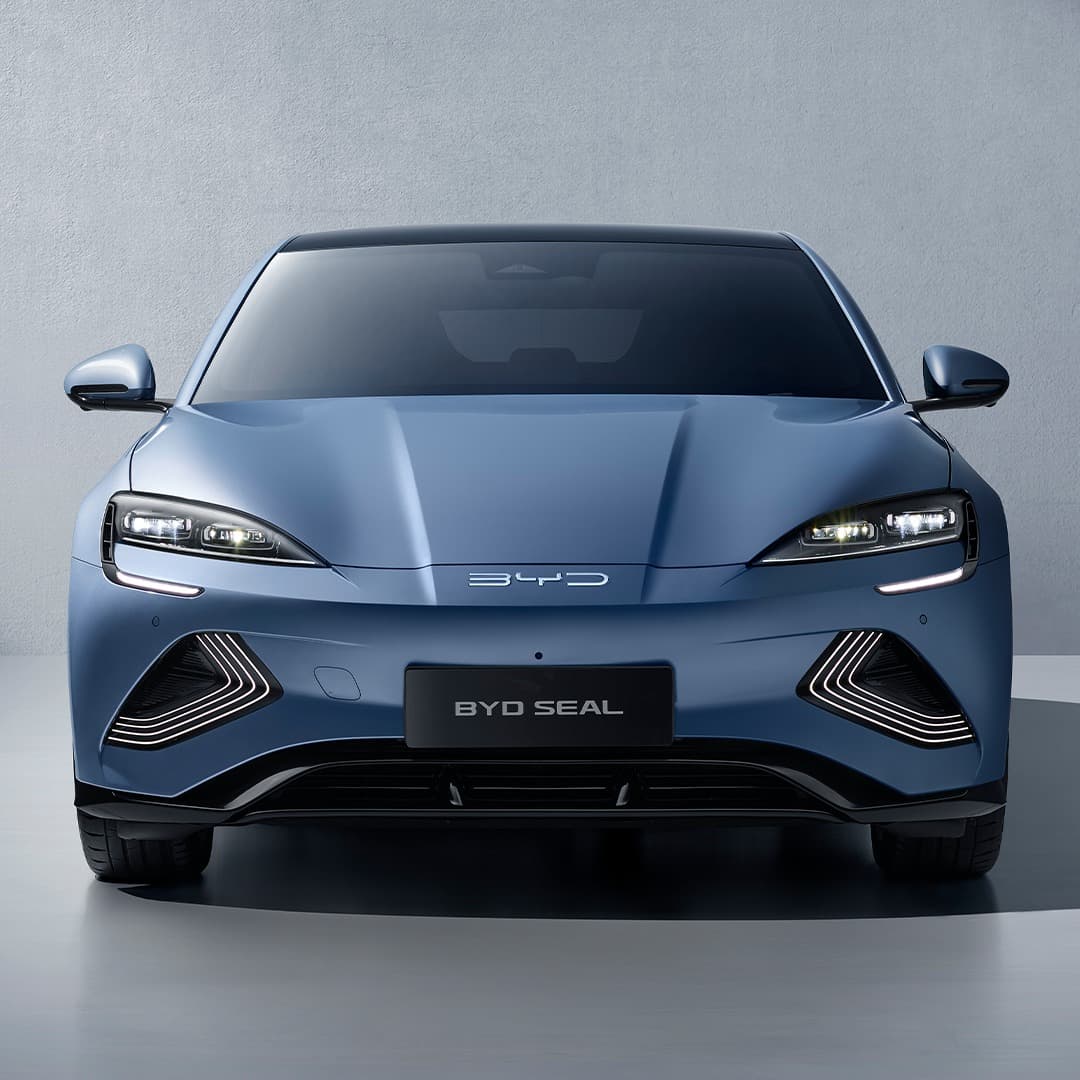
The Seal is where BYD shows off. A D-segment electric sedan inspired by ocean aesthetics, with up to 650 km of range and — in top spec — a 3.8-second 0–100 km/h time. At PKR 1.479 crore for the Dynamic and 1.699 crore for the Premium, it is the most directly Tesla-adjacent car BYD sells in Pakistan.
Honest take: Stunning value for what it is — a genuine sports sedan with EV performance — but this is an enthusiast's car. The resale market for a PKR 1.7 crore electric sedan in Pakistan does not yet exist. If you intend to keep it 6+ years, the proposition is compelling. If you flip cars every three years, proceed cautiously.
Sealion 6 — The Most Sensible BYD
The PHEV Sealion 6 is the car most Pakistani households should probably be considering even if they think they want a pure EV. Electric for the daily commute, petrol for everything else, no range anxiety, no charging planning. BYD has been slow to publicize Sealion 6 pricing in Pakistan (PakWheels still lists it as "Call for price" as of this writing), which is strange — this should arguably be their hero product for the mass market.
Honest take: On paper, the most pragmatic BYD in Pakistan. The ambiguous pricing and lower marketing profile suggest BYD may be positioning the Sealion 7 and Shark 6 as its attention-grabbers, but for a family buying their only car, the Sealion 6 logic is hard to argue with.
Sealion 7 — Premium EV SUV
Launched alongside the Atto 2 in January 2026 at PKR 15.49 million, the Sealion 7 targets the premium EV buyer who wants SUV practicality over sedan excitement. 308 horsepower, 380 Nm of torque, 0–100 in 6.7 seconds, 500+ km of range. It competes conceptually with the Hyundai Ioniq 5 and, more distantly, the Tesla Model Y.
Honest take: A well-executed premium EV. Whether it wins over Pakistani buyers in the PKR 1.5+ crore bracket depends on whether they see BYD as a premium brand yet — or whether they default to European alternatives when spending that money. The brand perception is shifting, but slowly.
Shark 6 — The PHEV Pickup Nobody Expected
At PKR 1.995 crore, the Shark 6 is Pakistan's first plug-in hybrid pickup. 436 horsepower combined, 650 Nm of torque, 0–100 in 5.7 seconds, 100 km of electric-only range, 800 km total range, 2,500 kg towing capacity. On spec, it flattens the Toyota Hilux. On price, it costs nearly double.
Honest take: The Shark 6 is a statement product more than a volume product. Pakistani pickup buyers are price-sensitive and conservative; they buy Hiluxes because Hiluxes never die and because every mechanic on GT Road can fix one. The Shark 6 is not competing with the Hilux — it is competing with the Prado for the affluent outdoorsman's second vehicle, and in that comparison it is genuinely compelling.
The Honest Concerns
A good analytical piece shouldn't just list strengths. BYD has real weaknesses in Pakistan, and buyers should weigh them.
Service network depth. BYD has showrooms in the major cities, but the countrywide service footprint of Toyota Indus Motor, Honda Atlas, or even MG is not comparable. If you break down in Multan or Peshawar, your Atto 3 is a harder problem than a Civic is.
Charging infrastructure. BYD has installed some DC fast chargers at its showrooms, and the government's tariff cut has encouraged third-party operators to expand, but the national network is nascent. Anyone buying a pure EV BYD in 2026 should plan to install home charging — Sealion 6 PHEV owners can skip this worry entirely.
Resale value uncertainty. Used BYD listings exist on PakWheels, but the volume is too thin to establish a reliable price curve. Buyers spending PKR 1.5+ crore should assume significant depreciation risk until the market matures. This is not a BYD-specific problem — it is a Chinese-brand-in-Pakistan problem — but the higher price points amplify it.
Chinese brand perception. Conservative buyers, particularly older buyers and buyers outside major cities, still associate Chinese cars with earlier generations of flimsy build quality. BYD's actual build quality is competitive with Japanese mainstream brands, but perception lags reality by roughly a decade.
Battery and EV-specific long-term unknowns. BYD's Blade Battery has strong global data for safety and durability, but no EV in Pakistan has a ten-year-old owner base here yet. Battery replacement costs on a 10-year-old Atto 3 are theoretical right now.
What BYD's Success Means for Pakistan
Step back from the model-by-model detail and the bigger story is this: BYD has established that a Chinese brand can enter Pakistan, commit serious capital, launch product quickly, and challenge the Japanese incumbents not on price but on technology. Every other Chinese brand in this series — MG, Haval, Changan, Deepal, and the Korean and Japanese pieces still to come — is now operating in a market BYD has partially reshaped.
For consumers, this is good news. More competition means more choice and, eventually, better pricing as local assembly scales. For Toyota, Honda, and Suzuki, it is a warning: the era of assuming a Corolla or Civic buyer will default to the familiar badge is ending.
For HUBCO shareholders, it is a bet whose next data point lands in today's earnings call.
Who Should Buy a BYD in 2026?
You should seriously consider a BYD if:
Your daily driving is predominantly urban and you can install home charging (pure EV)
You want electric-car efficiency without range anxiety (PHEV — Sealion 6)
You are willing to be an early adopter in exchange for tech and running-cost advantages
You plan to keep the car 5+ years and can absorb resale uncertainty
You should probably skip BYD for now if:
You live outside the major cities and drive long distances routinely
You intend to resell within 2–3 years
Your budget can't absorb the home-charging installation cost on top of the car price
You need a bulletproof service network — a Corolla is still the safer operational bet
The Series Continues
Next in this series: MG — The Quiet Volume Leader. While BYD has been grabbing headlines, MG has been doing something less flashy but arguably more important: selling cars at volume to mainstream Pakistani buyers who aren't yet ready to go electric. Published Tuesday.
Have thoughts on BYD's Pakistan strategy? We'd love to hear from current owners — what's the ownership experience actually like? Share your story at [contact link].
CarDeal.pk covers Pakistan's auto market with an analytical, opinionated voice. Browse new and used listings across Pakistan, check current PKR prices on every major make, and find dealers near you at cardeal.pk.
CarDeal
Bringing you the latest automotive news and insights from Pakistan