Toyota Indus Motor Company: Inside Pakistan's Most Profitable Automaker
Published July 2, 2026 · Part 8 of 12 in our Pakistan Auto Makers series
TL;DR
Indus Motor Company holds roughly 15.3% of Pakistan's car market by volume. Suzuki holds three times that. Yet IMC is, by a wide margin, the most profitable automaker in the country: PKR 19.39 billion profit after tax in the first nine months of FY2025-26, up from PKR 16.55 billion — including the company's best half-yearly result since 2014.
That profit machine runs on a simple formula: sell fewer cars at higher margins, own the premium segments outright (Fortuner, Hilux, Land Cruiser), keep the Corolla franchise unassailable on resale value, and let everyone else fight over the entry level. IMC sold 33,572 vehicles in nine months — up 53.4% — while investing PKR 5.1 billion in parts localization and starting Pakistan's first "Make in Pakistan" vehicle exports.
But the fortress has a gap, and the Chinese brands found it: there is nothing in Toyota's Pakistan lineup between the Corolla Cross (~PKR 1 crore) and the Fortuner (PKR 1.7+ crore) — exactly where the Haval H6, Tucson Hybrid, and Sportage HEV live, and exactly where Pakistani demand is moving. This piece covers how IMC makes its money, what the 2026 lineup actually offers, and whether the most disciplined player in Pakistani autos can defend a moat that's being attacked from the middle.
Every brand profile in this series so far has been about challengers: Chinese entrants building share from zero, Korean brands mounting comebacks. Toyota is different. Toyota is the incumbent — the brand every challenger in Pakistan measures itself against, the resale-value benchmark, the default answer to "which car should I buy?" for three decades.
What's less understood is the machine behind the brand. Indus Motor Company (PSX: INDU) is not the biggest carmaker in Pakistan — Suzuki sells roughly three cars for every Toyota. But on profit, it isn't close. IMC's nine-month FY26 profit of PKR 19.39 billion likely exceeds the combined profit of every other passenger-car assembler in the country. Its gross margins run above 15%. It pays dividends most industrial companies can only envy — PKR 51 per share declared in the latest quarter alone.
How does a company with 15.3% market share generate that? And can the formula survive the Chinese wave that this series has been documenting since April? Those are the two questions this post answers.
Who actually runs Toyota in Pakistan
Indus Motor Company is a joint venture between House of Habib (one of Pakistan's oldest industrial groups), Toyota Motor Corporation, and Toyota Tsusho Corporation (Toyota's trading arm). The company went public in December 1989 and began commercial production in May 1993 at its Port Qasim plant in Karachi.
Two structural details matter. First, unlike most Toyota distributors in emerging markets, IMC has Toyota itself on the shareholder register — which means Japan has skin in the game on localization decisions, model allocations, and long-term investment. Second, the Port Qasim facility is the only plant in the world where Toyota and Daihatsu vehicles are manufactured together, a quirk of history that gives IMC unusual flexibility in platform decisions.
The current CEO is Ali Asghar Jamali, who has run the company through both the 2022-23 collapse (when IMC repeatedly shut production for weeks at a time) and the current recovery. IMC's dealer network spans every major and most secondary Pakistani cities with full 3S (sales, service, spares) coverage — the deepest after-sales infrastructure of any brand except possibly Suzuki.
How IMC makes its money: the FY26 numbers
The nine-month results (July 2025 – March 2026) tell the story in four numbers:
33,572 vehicles sold — up 53.4% from 21,890 a year earlier
PKR 191.97 billion net sales — up from PKR 145.53 billion
PKR 19.39 billion profit after tax — EPS of PKR 246.80
~15.3% market share — in an industry that grew 42.8% to 144,029 units
Do the division and the structure becomes visible: IMC's average revenue per vehicle is roughly PKR 5.7 million — dramatically higher than Suzuki's, whose volume is concentrated in the Alto. IMC doesn't compete at the entry level at all. Its cheapest product, the Yaris, starts at PKR 4.65 million — above the top of Suzuki's core range. Everything else scales up from there: Corolla (PKR 6.1–7.7 million), Corolla Cross (~PKR 1 crore), Hilux, Fortuner (PKR 1.7+ crore), Land Cruiser (PKR 95 million, CBU).
The mix that matters most is the one few people talk about: Hilux and Fortuner. In the October–December quarter, Yaris, Corolla and Corolla Cross accounted for 9,094 units while Fortuner and Hilux added 1,580 — but those 1,580 IMV-platform vehicles carry the fattest margins in the lineup. The Fortuner and Hilux face no credible locally-assembled competition (the Isuzu D-Max sells in small volumes; GWM's Cannon Alpha and BYD's Shark 6 are just arriving). Where there's no competition, there's pricing power. That's the quiet engine of IMC's profitability.
Two more strategic moves round out the picture. IMC has now committed PKR 5.1 billion to parts localization — announced incrementally, most recently an additional PKR 1 billion approved in April 2026 — which compresses import costs and insulates margins from rupee volatility. And in July 2024 the company began Pakistan's first meaningful passenger-vehicle exports, a small but symbolically important hedge against domestic demand cycles.
The Toyota Pakistan lineup in 2026
Model | Type | Indicative price (PKR, ex-factory) |
|---|---|---|
Yaris | Compact sedan | from 4,649,000 |
Corolla Altis | Mid-size sedan | 6,099,000 – 7,709,000 |
Corolla Cross (Petrol Low/High) | Compact crossover | ~9,000,000+ |
Corolla Cross (HV Mid/High) | Hybrid crossover | ~10,000,000 – 11,000,000+ |
Hilux (Revo/Rocco range) | Pickup truck | varies by variant |
Fortuner (2.7G to GR-S) | Body-on-frame SUV | from ~17,000,000 |
Camry | Premium sedan (CBU) | varies |
Hiace | Commercial van | varies |
Land Cruiser | Full-size SUV (CBU) | 95,000,000 |
Prices are indicative ex-factory as of mid-2026 and move frequently — IMC revised freight charges across all models in April 2026 (adding PKR 30,000–296,000 depending on model and region). Confirm current pricing with an authorized Toyota dealer before booking. We update these prices quarterly.
The Corolla: the franchise
The Corolla has been Pakistan's default family sedan for over 30 years, and its position is less about the car than about the ecosystem around it: every mechanic in every city knows it, every parts bazaar stocks it, and its resale value is the standard against which every other car in Pakistan is measured. The current Altis range (1.6L and 1.8L) is mature — the global Corolla is a generation ahead — but in Pakistan, familiarity is the feature.
The honest assessment: on equipment and technology, a Corolla Altis at PKR 7.7 million is outgunned by nearly every Chinese competitor at the same price. On total five-year ownership cost — purchase, maintenance, resale — it remains extremely hard to beat. Which of those matters more depends entirely on how long you keep your cars.
The Yaris: the volume workhorse
The Yaris was launched in 2020 to defend the B-segment against the Honda City, and it has done exactly that — it's consistently among Pakistan's top-selling sedans. IMC has used it tactically, cutting prices when needed (most recently a headline-making Yaris price reduction) and running 35th-anniversary promotions on the 1.3 GLI CVT. At PKR 4.65 million, it's Toyota's entry ticket, and the margin structure suggests IMC treats it as a customer-acquisition product: get the buyer into the Toyota ecosystem young, keep them through Corolla, Cross, and Fortuner over a lifetime.
The Corolla Cross: the hybrid bet
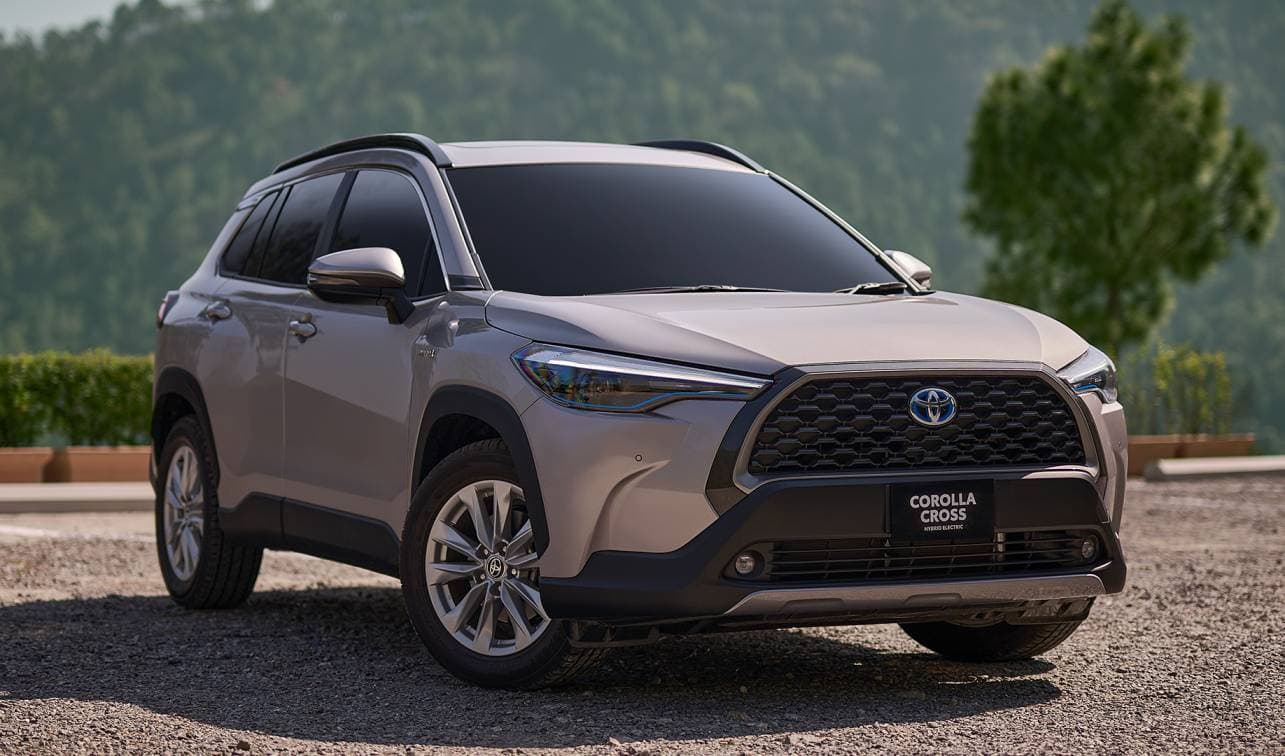
The Corolla Cross is IMC's most strategically important product of the decade — its answer to the SUV shift and its first locally-assembled hybrid. Four variants: Petrol Low, Petrol High, HV Mid, HV High. The HV variants pair a 1.8L petrol engine (98 hp) with a 72 hp electric motor for genuine Toyota hybrid economics — the technology Toyota has refined longer than any automaker on earth.
The Cross sells steadily, but its competitive position is under more pressure than IMC's marketing admits. At roughly PKR 1 crore for the hybrid variants, it faces the Haval H6 HEV (more features, more space, similar price), the Hyundai Tucson Hybrid (PKR 11.22M, bigger class), and the MG HS Hybrid+ (PKR 9.49M, undercutting it). What the Cross has that they don't: Toyota's hybrid reliability record and the strongest resale value in the segment. For a 3–4 year owner, that resale gap still decides the purchase. For longer horizons, the value argument has genuinely narrowed.
Hilux and Fortuner: the profit engine
The IMV platform twins are where IMC's pricing power lives. The Hilux is Pakistan's default premium pickup — agricultural, commercial, security, and status buyers all in one product line. The Fortuner range now stretches from the 2.7G to the GR-S (the variant IMC famously presented to Olympic gold medalist Arshad Nadeem). No locally-assembled competitor has meaningfully dented either nameplate in a decade.
That is precisely why the next 18 months matter: the GWM Cannon Alpha PHEV (via Sazgar) and the BYD Shark 6 PHEV are the first credible attacks on Hilux territory in years, and Sazgar's Tank-500 PHEV aims directly at the Fortuner buyer. If those products land well, the pressure arrives at the exact segment funding IMC's profitability.
What's conspicuously missing
Three absences define Toyota Pakistan's risk profile more than anything in its lineup:
No mid-size hybrid SUV. Nothing between Corolla Cross and Fortuner — no locally-assembled RAV4, no Hyryder. This is the fastest-growing segment in Pakistan and Toyota simply isn't in it.
No EV, and no announced EV plan for Pakistan. The bZ4X exists globally; there is no official Pakistani launch. As BYD's local assembly starts and Hyundai/Kia build EV lineups, Toyota's EV absence gets more visible each quarter.
No refreshed entry product. The Yaris and Corolla platforms are aging. Toyota's global cadence will eventually deliver updates, but "eventually" is doing a lot of work while Chinese competitors refresh every 24 months.
Why Toyota's moat holds — for now
Skeptics have predicted Toyota's decline in Pakistan before, and been wrong every time. The moat has four layers, and it's worth being precise about which are eroding and which aren't:
Resale value (intact). A three-year-old Corolla still recovers a higher percentage of its purchase price than any competitor. This single fact anchors hundreds of thousands of purchase decisions and shows no sign of weakening yet.
After-sales ecosystem (intact). Full 3S dealer coverage, plus the informal ecosystem — every roadside mechanic in Pakistan can service a Toyota. Chinese brands are 5–10 years from replicating this.
Hybrid credibility (intact but contested). Toyota invented the mass-market hybrid, and Pakistani buyers know it. But Haval, MG, Hyundai, and Kia now all sell hybrids locally, and the "only trustworthy hybrid" positioning is no longer exclusive.
Product superiority (eroded). This is the honest one. Feature-for-feature and rupee-for-rupee, Chinese competitors now beat every Toyota passenger product on equipment. Toyota wins the purchase despite the spec sheet, not because of it.
The formula that follows: Toyota keeps winning buyers who optimize for total ownership cost and predictability, and keeps losing buyers who optimize for what the car offers today. The strategic question is which group grows faster — and among under-40 urban buyers, the evidence from Haval's rise suggests the second group.
What this means if you're considering a Toyota in 2026
The Corolla Cross HV if resale is in your top two criteria
If you keep cars 3–4 years and resale value materially affects your finances, the Corolla Cross HV remains the rational pick in the compact hybrid crossover segment despite thinner equipment than the Haval H6 HEV. If you keep cars 6+ years and resale matters less, drive both before defaulting to Toyota — the H6's advantage in daily-use features is real.
The Corolla or Yaris if you want the lowest-risk ownership in Pakistan
Nothing in Pakistan is cheaper to own over a decade than a Corolla, full stop. Parts, mechanics, resale, reliability — the ecosystem does the work. The trade-off is paying 2026 prices for a package that feels like 2020. For buyers in smaller cities where Chinese-brand service coverage is thin or absent, the calculation tilts even further toward Toyota.
The Fortuner and Hilux — still default, but watch the next six months
If you need a body-on-frame SUV or premium pickup today, the Fortuner and Hilux remain the standard choices with unmatched resale. But if your purchase can wait until late 2026, the Tank-500 PHEV, Cannon Alpha PHEV, and BYD Shark 6 will all be established by then — and even if you still buy the Toyota, their arrival may pressure IMC into the kind of pricing and variant moves that reward patient buyers.
Don't wait for a Toyota EV
There is no announced Toyota EV for Pakistan. If you want an electric vehicle in the near term, the realistic options are BYD, Deepal, the Hyundai Ioniq lineup, or the Kia EV5 — not Toyota. Waiting for a hypothetical Toyota EV means waiting indefinitely.
The 2026–2028 outlook for Toyota IMC
Three things to watch:
Whether IMC brings a mid-size hybrid SUV to Pakistan. A locally-assembled Hyryder, RAV4, or equivalent between Cross and Fortuner is the single most obvious move on the board. IMC's PKR 5.1 billion localization program and Toyota's shareholder seat make it feasible; every quarter of delay hands the segment to Haval, Hyundai, and Kia. We'd put a Pakistan announcement in the next 18 months at better-than-even odds — the gap is too profitable to leave open.
How IMC responds to the Hilux/Fortuner attack. Watch for variant expansion, hybrid IMV powertrains (Toyota has them globally), and tactical pricing through 2027. IMC has never faced real competition in this segment; how it behaves under pressure is genuinely unknown.
Policy exposure. IMC's CEO has been vocal that the sector's recovery rides on policy continuity — rational taxation, financing access, and the end of the used-import baggage scheme (which IMC welcomed). A policy swerve in either direction moves IMC's numbers more than any competitor action.
Our take: IMC's profitability is secure through 2027 — the Hilux/Fortuner engine and the Corolla franchise don't erode quickly, and the balance sheet is a fortress. But market-share defense in passenger cars is a different story. Without a mid-size SUV entry, Toyota's Pakistan volume share drifts down even as its profits hold — a smaller, richer company. Whether Toyota Japan accepts that trajectory for its fifth-most-populous market is the most interesting open question in Pakistani autos.
Sources & methodology
Financial figures from IMC's unaudited 9MFY26 results (announced April 2026) as reported by The News and The Nation, and 1HFY26 results via Business Recorder. Pricing from Toyota Indus official site, PakWheels, and authorized dealer listings (verified July 2026); April 2026 freight revision via Pakistan Observer. Corporate structure from PSX filings and toyota-indus.com. Prices change frequently — confirm with an authorized Toyota dealer before booking.
Frequently asked questions
Who owns Toyota in Pakistan?
Toyota vehicles in Pakistan are assembled and sold by Indus Motor Company (IMC), a joint venture between House of Habib, Toyota Motor Corporation, and Toyota Tsusho Corporation. IMC is listed on the Pakistan Stock Exchange (PSX: INDU) and operates its plant at Port Qasim, Karachi — the only facility in the world where Toyota and Daihatsu vehicles are manufactured together.
Is the Toyota Corolla Cross hybrid worth it in 2026?
The Corolla Cross HV offers Toyota's proven hybrid system and the strongest resale value in its segment. Competitors like the Haval H6 HEV offer more features and space at similar prices. For 3–4 year ownership horizons where resale matters, the Cross remains the rational pick; for longer ownership, test-drive the Chinese and Korean alternatives before deciding — the value gap has narrowed considerably.
Why is Toyota so profitable in Pakistan despite lower sales than Suzuki?
IMC's product mix is concentrated in higher-priced, higher-margin segments. Its cheapest car (Yaris, ~PKR 4.65 million) starts above most of Suzuki's range, while the Hilux, Fortuner, and Land Cruiser face little direct locally-assembled competition, giving IMC unusual pricing power. In the first nine months of FY2025-26, IMC earned PKR 19.39 billion in profit on roughly 15.3% market share.
Does Toyota sell electric cars in Pakistan?
No. As of mid-2026, Toyota has no officially launched electric vehicle in Pakistan and no announced Pakistani EV plan. Its electrified offering locally is the Corolla Cross hybrid (HV variants). Buyers wanting a full EV with official local support currently need to look at BYD, Deepal, Hyundai's Ioniq lineup, or the Kia EV5.
What is the cheapest Toyota in Pakistan in 2026?
The Toyota Yaris, starting at approximately PKR 4,649,000 ex-factory for the base variant. Note that IMC revised freight charges in April 2026, adding PKR 30,000–125,000 to on-road costs for the Yaris depending on your region, so the final delivered price varies by city.
Will Toyota launch a new SUV in Pakistan?
Nothing has been officially announced. However, the gap in Toyota's Pakistan lineup between the Corolla Cross and Fortuner — exactly where the Haval H6, Hyundai Tucson, and Kia Sportage compete — makes a mid-size SUV launch (such as a locally assembled Hyryder or RAV4 derivative) a widely expected move. Treat any specific launch claim as rumor until IMC confirms it.
Browse Toyota listings on CarDeal.pk
Looking at a specific Toyota? CarDeal.pk has new and used listings across the lineup, with AI-powered search that handles natural queries like "white Corolla Cross HV Lahore under 1.1 crore" or "Fortuner Legender Karachi":
Also see our model-level deep dives: the Toyota Corolla 2026 Buyer's Guide, Toyota Yaris 2026 Buyer's Guide, and Toyota Corolla Cross 2026 Buyer's Guide.
More in this series
Part 2: BYD in Pakistan — The Most Ambitious Chinese Entry Yet
Part 3: MG in Pakistan — From EV Pioneer to Mainstream Contender
Part 4: Haval & Sazgar — Why the H6 Is the Surprise #2 Car in Pakistan
Part 8: Toyota Indus Motor Company (this post)
Part 9: Honda Atlas — The Civic-Dependency Problem (coming next)
Last updated: July 2, 2026. This article is reviewed quarterly.
CarDeal
Bringing you the latest automotive news and insights from Pakistan